

The finance Rule of 72 is one of the easiest ways to estimate how long it may take for an investment to double in value. It is widely used in personal finance, investing, savings planning, and financial literacy because the formula is simple and easy to understand. Even beginners can use it without advanced math skills.
This rule helps people make smarter financial decisions by showing how compound interest works over time. It also highlights the importance of starting investments early and choosing growth opportunities with better long-term returns.
What Is the Rule of 72 and How Does It Work?
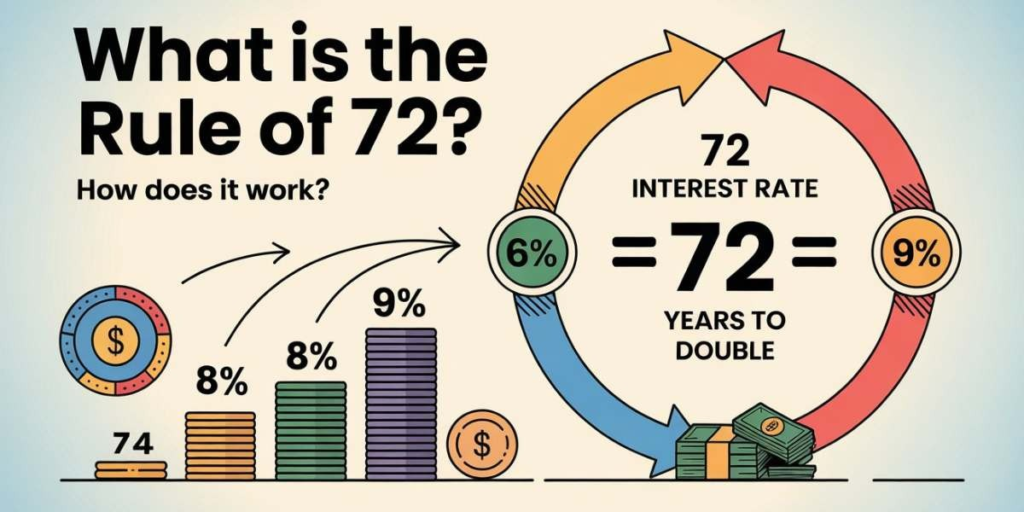
The Rule of 72 is a financial formula used to estimate how many years it takes for money to double at a fixed annual interest rate. The formula works by dividing 72 by the annual rate of return or interest rate.
Years to Double Investment=72Interest Rate\text{Years to Double Investment} = \frac{72}{\text{Interest Rate}}Years to Double Investment=Interest Rate72
For example, if an investment grows at 8% annually, dividing 72 by 8 gives 9 years…
Understanding the Finance Rule of 72 Formula

The finance Rule of 72 formula is popular because it simplifies investment calculations. Instead of using complex compound interest equations, investors can quickly estimate growth using basic division. This makes financial planning easier and more practical.
The formula works best with moderate interest rates and long-term investments. It is commonly used for retirement planning, savings growth estimates, and comparing investment opportunities.
Finance Rule of 72 Example for Beginners

A simple Rule of 72 example can make the concept easier to understand. Suppose you invest money with a yearly return of 6%. By dividing 72 by 6, you get 12 years. This means your investment could potentially double in about 12 years.
If the return increases to 9%, the investment may double in around 8 years. This example clearly shows how higher interest rates can accelerate wealth growth over time.
How Compound Interest Makes the Rule of 72 Powerful
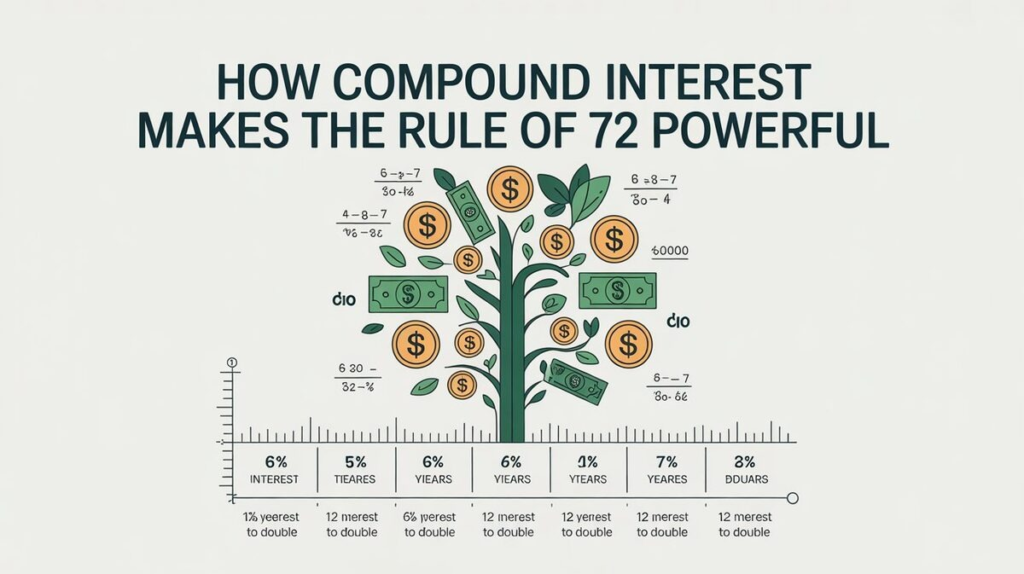
The Rule of 72 is closely connected to compound interest because compound growth increases investment value over time. Instead of earning returns only on the original investment, compound interest allows earnings to grow on previous profits as well.
This snowball effect is one of the biggest reasons why long-term investing can create significant wealth. The Rule of 72 helps investors visualize the impact of compound interest in a simple and practical way.
Using a Rule of 72 Calculator for Faster Results

Many people use a Rule of 72 calculator online to estimate investment doubling time instantly. These calculators save time and help users compare different interest rates and investment scenarios more efficiently.
Online calculators are especially useful for beginners learning financial planning concepts. They make investment analysis easier without requiring manual calculations or advanced financial knowledge.
Rule of 72 Compound Interest and Wealth Building
The Rule of 72 compound interest principle demonstrates how consistent investing can lead to long-term financial growth. Even small investments can grow substantially if they remain invested long enough with steady returns.
This concept encourages disciplined saving and long-term investing habits. It also explains why financial experts often recommend starting investments early rather than waiting for the “perfect” time.
Read more https://checkmygpa.com/ust-university-bangladesh/
Rule of 72 Derivation Explained Simply
The Rule of 72 derivation comes from logarithmic calculations related to compound growth formulas. While the mathematical explanation is more advanced, the simplified version was designed to help people estimate investment growth quickly without calculators.
Financial professionals use the rule because it provides reasonably accurate estimates for common interest rates. Although not perfectly exact, it remains one of the most practical shortcuts in finance.
How Accurate Is the Rule of 72 in Real Investing?
Many people wonder whether the Rule of 72 actually works in real-world investing. The answer is yes, but it works best for moderate interest rates between 6% and 10%. At very high or low rates, the estimates may become less precise.
Despite minor limitations, the rule is still widely respected because it provides quick and useful financial insights. Investors often use it as a general planning tool rather than an exact prediction method.
Difference Between Rule of 72 and Rule of 69
The Rule of 69 is another financial formula sometimes used for continuous compound interest calculations. While the Rule of 72 is more common and easier for everyday use, the Rule of 69 can provide slightly more accurate estimates in certain situations.
However, the Rule of 72 remains more popular because it is simpler to calculate mentally and works well for most investment scenarios.
Personal Finance Benefits of Understanding the Rule of 72
Learning the Rule of 72 can improve financial literacy and investment confidence. It helps people understand how inflation, interest rates, and investment returns affect wealth over time. This knowledge supports better saving and retirement planning decisions.
Understanding this simple rule can also motivate people to start investing earlier and focus on long-term financial growth rather than short-term market fluctuations.
Final Thoughts on the Finance Rule of 72
The finance Rule of 72 is one of the simplest yet most powerful concepts in investing and personal finance. It helps estimate how quickly investments may grow while teaching the importance of compound interest and long-term planning.