
Ever wondered how to calculate PayPal fees before hitting send on that invoice? Most people don’t until they check their balance and realize PayPal already helped itself to a chunk of it.
You send $500. You get $482. That missing $18 didn’t vanish into thin air PayPal took it before the money even landed in your account. The frustrating part? It didn’t have to be a surprise. Once you know the formula, you’ll never be caught off guard again.
That’s exactly what this guide covers — the exact calculation, the latest 2026 rates, real examples for common amounts, and how to stop losing more than you should. Let’s get into it.
The Formula It’s Simpler Than You Think
Every PayPal fee follows the same structure, no matter what type of transaction you’re doing. It’s always a percentage of the amount plus a small flat fee on top. That’s it.
Fee = (Amount × Percentage) + Fixed Fee
For example, the standard US Goods and Services rate is 3.49% plus $0.49. So on a $100 payment it looks like this:
($100 × 0.0349) + $0.49 = $3.49 + $0.49 = $3.98 total fee
You receive: $96.02
That’s $3.98 gone on a $100 transaction. Not a disaster but it adds up fast when you’re processing dozens of payments a month.
Current PayPal Fee Rates for 2025-2026
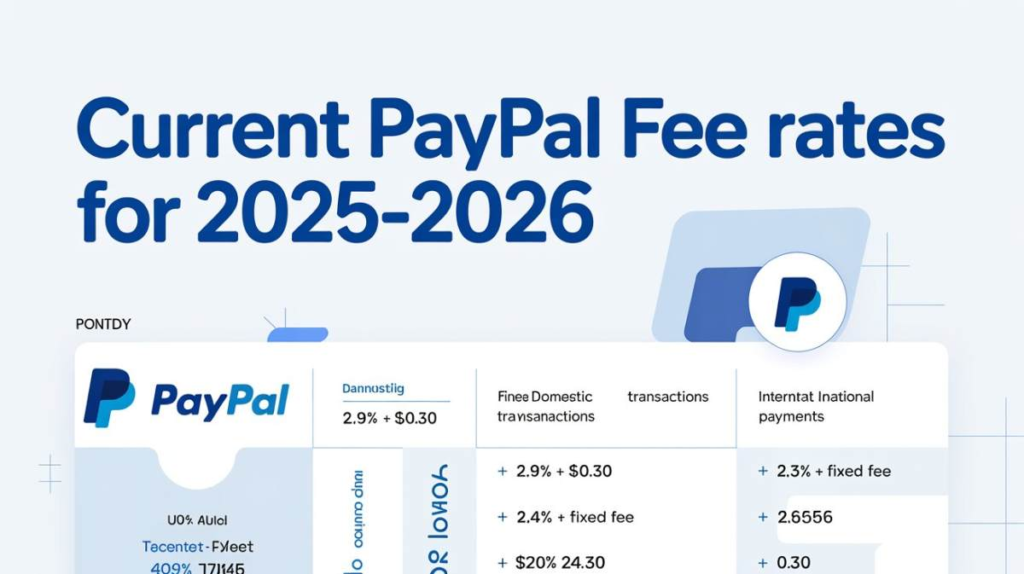
PayPal tweaked several rates in late 2025, particularly for international payments and micropayments. Here’s where things stand right now for US accounts.
| Transaction Type | Rate | Fixed Fee |
| Goods and Services (standard) | 3.49% | $0.49 |
| Goods and Services (send/receive) | 2.99% | $0.49 |
| Credit or Debit Card | 2.99% | $0.49 |
| QR Code Payment | 2.29% | $0.09 |
| Invoicing via PayPal or Venmo | 3.49% | $0.49 |
| Invoicing via Card or Apple Pay | 2.99% | $0.49 |
| Pay Later or Installments | 4.99% | $0.49 |
| Micropayments (small amounts) | 4.99% | $0.09 |
| International Cross-Border | 4.49% | $0.49 |
| Friends and Family (domestic) | 0% | Free |
Always double-check at paypal.com/us/webapps/mpp/merchant-fees — PayPal updates these without making a big announcement about it.
Real Examples What You Actually Receive
PayPal Fee on $100
Fee comes to $3.98. You receive $96.02. If you need to receive exactly $100, you’d need to ask the client to send $104.13. We’ll show you how to calculate that in a moment.
PayPal Fee on $1,000
This is where it starts to feel real.
($1,000 × 0.0349) + $0.49 = $34.90 + $0.49 = $35.39 in fees
You receive: $964.61
You just lost $35 on a four-figure payment. That’s a decent lunch. Or, if you’re invoicing regularly, that’s several hundred dollars a year going quietly to PayPal.
PayPal Fee on $3,000
($3,000 × 0.0349) + $0.49 = $104.70 + $0.49 = $105.19 in fees
You receive: $2,894.81
Over $105 on a single payment. That’s not small change. At this level, building fees into your pricing isn’t optional it’s just smart business.
Goods and Services vs Friends and Family Know the Difference
This is the one thing most people get wrong and getting it wrong can cost you in more ways than just fees.
Goods and Services is PayPal’s commercial payment option. When someone pays you for work, a product, or a service, this is the correct option. The recipient pays the fee. Both the buyer and seller are covered by PayPal’s Purchase Protection meaning if something goes wrong, PayPal can step in, investigate, and issue refunds where appropriate.
Friends and Family is for personal transfers splitting dinner, paying your flatmate back, sending money to a family member abroad. Domestic transfers are completely free. But there is zero Purchase Protection. If someone pays for a product using Friends and Family and the item never arrives, PayPal will not help them. There’s nothing to escalate. It’s gone.
Some sellers push buyers to use Friends and Family to dodge the fee. Apart from violating PayPal’s terms of service, it’s a genuinely bad deal for the buyer. Don’t be that seller.
International Payments The Hidden Cost Most People Miss
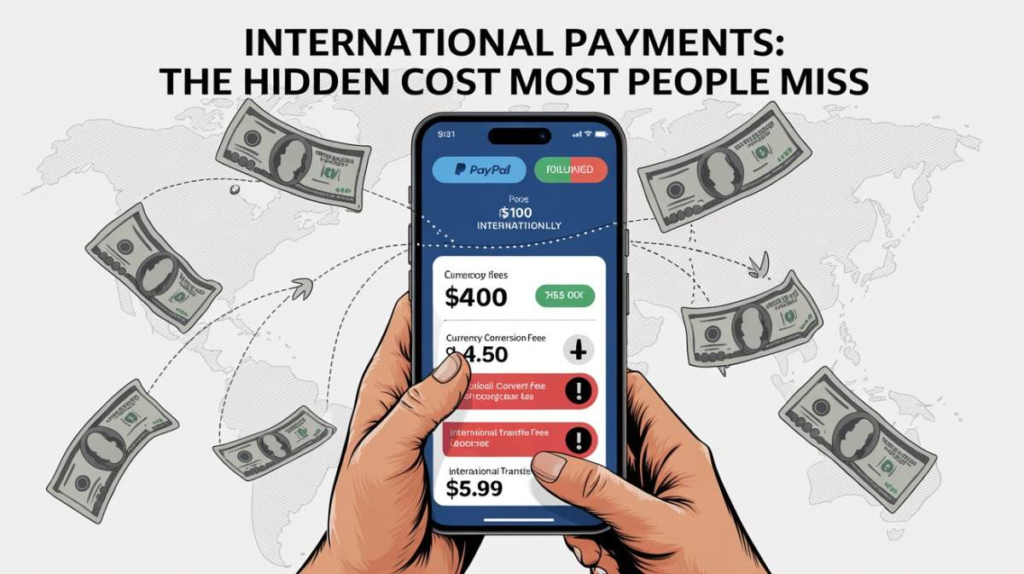
If you’re getting paid from another country, the fee structure changes and not in your favour. International cross-border commercial transactions carry a 4.49% rate plus $0.49, compared to 3.49% for domestic payments. That extra percentage point sounds small. On $1,000 it’s an extra $10. On $5,000 it’s an extra $50.
But the bigger hidden cost is currency conversion. When PayPal converts a foreign currency payment into your local currency, it doesn’t use the mid-market exchange rate you’d see on Google. It applies its own rate, which typically includes a 3 to 4% spread built in. On a $1,000 international payment, your total effective cost transaction fee plus conversion spread can easily land around $75 or more.
That’s why a lot of freelancers working internationally have shifted to Wise or Payoneer for cross-border payments. Both use the mid-market rate and charge a transparent flat fee. For regular international payments, the savings add up quickly.
Read more https://checkmygpa.com/how-to-raise-a-2-5-gpa-to-a-3-0/
The Gross-Up Formula How to Make Sure You Get Paid What You Quoted
Here’s the situation: you want to receive exactly $500 after fees. If you invoice for $500, you’ll receive $482.56 not $500. To land on exactly $500 net, you need to charge more upfront. The formula for working this out is:
Gross Amount = (Net Amount + Fixed Fee) ÷ (1 − Percentage Rate)
Plugging in $500 at 3.49% + $0.49:
($500 + $0.49) ÷ (1 − 0.0349) = $500.49 ÷ 0.9651 = $518.58
Invoice for $518.58. After PayPal takes its $18.58, you receive exactly $500. Clean, simple, and no surprises on either side.
How to Reduce What You Pay in PayPal Fees
- Build fees into your pricing from day one. The cleanest approach quote a price that already accounts for the fee, so what you quote is what you keep.
- Use QR code payments for in-person transactions. At 2.29% it’s PayPal’s lowest commercial rate and genuinely worth using if you sell face-to-face.
- Use the gross-up formula on invoices. When a client must pay through PayPal, charge the grossed-up amount so the fee falls on the transaction, not your pocket.
- Switch to Wise for international payments. Mid-market exchange rates and transparent flat fees make it significantly cheaper for cross-border work.
- Ask about merchant pricing if your volume is high. PayPal offers custom rates to businesses processing over $10,000 monthly you have to ask, but it’s available.
- Never misuse Friends and Family for commercial payments. The short-term fee saving isn’t worth the risk to both parties or the potential account suspension.
Frequently Asked Questions
How much does PayPal goods and services fee cost?
The standard US rate is 3.49% plus $0.49 per transaction. On $100 that’s $3.98. On $1,000 that’s $35.39. The fee is deducted from what the recipient receives.
What are PayPal fees on $1,000?
At 3.49% + $0.49, you lose $35.39 on a $1,000 Goods and Services payment and receive $964.61. For an international payment at 4.49% + $0.49, the fee rises to $45.39.
How do I avoid a 3% fee on PayPal?
For personal transfers use Friends and Family it’s free domestically. For commercial payments, use QR codes (2.29%), build fees into your pricing, or use the gross-up formula to pass the cost to the buyer fairly.
Does PayPal charge a fee to receive $3,000?
Yes $105.19 at the standard 3.49% + $0.49 rate. You receive $2,894.81. To receive exactly $3,000 net, invoice for $3,107.36.
What are PayPal fees for receiving money internationally?
4.49% + $0.49 for cross-border commercial transactions, plus a 3 to 4% currency conversion spread. On a $1,000 international payment your total effective cost can exceed $75.
How much is the PayPal fee for $100?
$3.98 using the standard Goods and Services rate. You receive $96.02. To receive exactly $100, ask the sender for $104.13.