
I used to judge investments mainly by looking at the percentage return. If something offered 8% or 10%, it sounded good on paper, but I never truly understood what that meant in real life. That changed when I started using a simple mental model to estimate doubling time of money with Rule of 72.
Instead of focusing only on returns, I began thinking in terms of time. How long will it actually take for my money to double? That one shift made financial decisions far clearer and more practical.
Quick Reference for Doubling Time
Before going deeper into the concept, it helps to see how different returns translate into actual time. Over time, I realized that remembering a few benchmarks is far more useful than calculating everything from scratch.
| Interest Rate | Years to Double | What It Means |
| 6 percent | 12 years | Slow but stable growth |
| 8 percent | 9 years | Balanced and consistent |
| 10 percent | about 7 years | Strong long-term growth |
| 12 percent | 6 years | Fast compounding effect |
| 15 percent | under 5 years | Aggressive growth |
This simple view helps you instantly connect returns with time. After a while, you stop thinking in percentages and start thinking in timelines, which is far more useful in real decision-making.
What Is the Rule of 72 and Why It Works
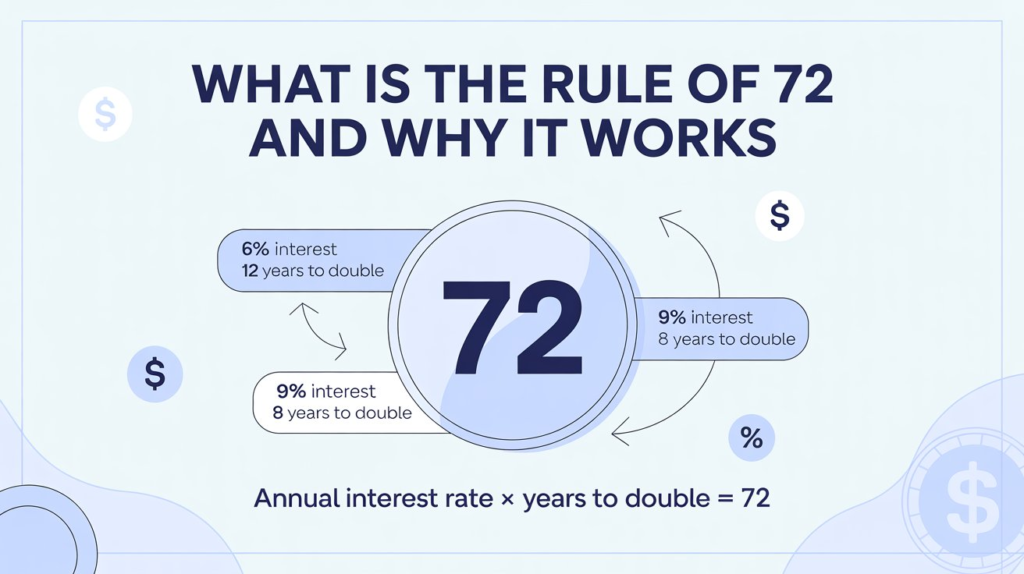
The Rule of 72 is a quick financial shortcut used to estimate how long it takes for an investment to double due to compound interest. The idea is simple: you divide 72 by the annual rate of return, and the result gives you the approximate number of years required for your money to double.
For example, if your investment earns 9% annually, dividing 72 by 9 gives 8 years. That means your money is expected to double in roughly 8 years.
The reason this works is practical rather than theoretical. The number 72 is highly divisible by many common interest rates, making mental calculations quick and convenient.
How to Use the Rule of 72 in Real Life
The real value of this rule becomes clear when you start applying it to actual financial decisions. Instead of comparing investments only based on percentage returns, you begin comparing them based on time.
For example, a 7% return might take around 10 years to double, while a 9% return takes closer to 8 years. The difference may seem small in percentage terms, but over time it creates a meaningful gap in wealth accumulation.
This perspective helps you evaluate opportunities more realistically, especially when planning long-term investments.
Formula for the Rule of 72
The formula is straightforward:
To determine how long it takes for your investment to double, simply divide 72 by your annual interest rate.
For example, if the return is 12%, then 72 divided by 12 equals 6 years.
If you prefer structured tools, you can also calculate this in Excel using the same logic by dividing 72 by the interest rate value in a cell. However, the main purpose of this rule is speed and simplicity, not technical calculation.
Accuracy and Practical Limitations

The Rule of 72 works best when interest rates are in a moderate range, typically between 6% and 10%. Within this range, it provides a reasonably close estimate.
However, it is still an approximation. It does not include real-world factors such as taxes, inflation, fees, or fluctuating returns. Because of this, it should be used as a quick estimation tool rather than a precise forecasting method.
Read more https://checkmygpa.com/best-universities-in-pakistan/
Rule of 72 vs Rule of 73
There is also a variation known as the Rule of 73, which can sometimes provide slightly better accuracy, especially in continuous compounding scenarios. However, it is less commonly used because it is harder to calculate mentally.
In most practical situations, the Rule of 72 remains the preferred choice due to its simplicity and ease of use.
Using the Rule of 72 in Calculators and Excel

While the Rule of 72 is designed for mental math, you can also use it in digital tools. In Excel, you can simply divide 72 by the interest rate to get the doubling time.
There are also online calculators available that provide more precise results. A practical approach is to first use the Rule of 72 for quick estimation and then switch to a calculator when making final financial decisions.
Final Thought
The Rule of 72 is not just a formula; it is a way of thinking. It shifts your focus from abstract percentages to real-world timeframes. Once you start seeing money in terms of how long it takes to grow, financial decisions become more intuitive and grounded.
Frequently Asked Questions
How do you calculate investment doubling time using the Rule of 72?
You divide 72 by the annual return rate. For example, 72 divided by 8 gives 9 years, meaning your money doubles in about 9 years.
Why is the Rule of 72 useful?
It helps investors quickly understand the relationship between returns and time without needing complex calculations. It makes financial comparisons easier and faster.
How accurate is the Rule of 72?
It is fairly accurate for moderate interest rates but becomes less precise for very high or very low returns. It should be used for estimation, not exact forecasting.
What is the difference between the Rule of 72 and Rule of 73?
The Rule of 73 can be slightly more accurate in certain cases, but the Rule of 72 is more widely used because it is easier to calculate mentally.
Is it possible to use the Rule of 72 for understanding inflation and debt as well?
Yes, it can also be applied to inflation and debt. It helps estimate how quickly purchasing power declines or how fast debt can grow if left unmanaged.